Essay
Routines are more than just habits—they’re the building blocks of a life lived with intention. When designed thoughtfully, they provide structure, foster creativity, and bring balance to your relationships, work, and personal growth. The rhythms you choose for your days lay the foundation for the life you want to create.
A routine is a powerful tool on the path to living your most empowered life. It has the potential to help you in every single area of your life, but you have to dial it in and determine what exactly your own personal needs are first—the needs of your body, mind and spirit. Having different routines for different purposes is a surefire way to help you and your family stay on track—to stay focused on what actually matters.
Lets talk about how you can build your own, and along the way I’ll give you some examples from my own life as some inspiration. Even if you are already someone who lives in routine, you will find something of value here, so keep reading.
First, lets make sure we understand the concept of a routine and why exactly it works. When we establish a routine, we are setting up a program of specific actions that we will take in the same way very regularly. This is the foundation of a routine, it must be the exact same, otherwise it wont work and we are talking about something else.
Think about baking a cake. This is usually a complex mixture of several ingredients with a few different stages: dry ingredients, wet ingredients, baking in oven. You can certainly just ‘wing it’ and randomly combine things together you think might work. This will, as many can attest, sometimes result in the most delicious cake ever. Often though, this way of baking will leave you wanting. And, if you do happen to get that most delicious cake ever, it will be hard to replicate it if you didn’t write down the recipe.
However, if you write down the recipe and follow it, after a few times making this cake you might try altering the amount of certain ingredients, or adding things entirely new. If you continue to write things down and observe, you will eventually start to understand exactly what effects each ingredient are having on the final product. If you randomly combine, there is no way to learn what specifically each thing is doing in the recipe.
This is the power of routine (and recipes). Thinking of your life, how would you ever truly understand how all the different things you are doing are actually affecting you, if every day you do things differently? Routines are the calm amidst the chaos, the background by which you can measure everything else. Routines allow you the opportunity to experiment and gain valuable data about your specific situation. The absence of routines therefore make this nearly impossible.

Let’s say you want to find out the best time wake up in the morning, as you’ve watched a video or read an article that claimed you will feel better if you get up earlier. You start your own experiment: day 1 you wake up at 6am, day 2 at 7am, and day 3 at 8am. Throughout the day afterwards you note periodically your state of focus, energy and mental clarity.
If it’s not already obvious to you, without some strict routines this experiment will provide exactly zero valuable insights into your best wake up time. What did you do after you woke up? If one day you walked the dog and the other day you scrolled social media, then that certainly affected your experiment. If one day you had a sugary treat and the other day you had a can of tuna, that will affect you also.
To be able to run an experiment like this on your own life—and actually obtain valuable insights from the results—you need to already have routines in place. What’s more, changes in our routines take time to propagate. This is the nature of being human. If you have ever had to suddenly change your sleep schedule, you probably already understand this. The first couple days might be difficult and cause grogginess, but after a few days you have adjusted and its fine.
My morning routine
Let’s look at my morning routine now to help illustrate some of these points. I wake up every morning at 4am—an hour and a half before sunrise here in Costa Rica. Sometimes I will be awake in bed before that thinking about my dreams, but I usually don’t get out of bed until 4am. A small timex watch on my nightstand beeps to signal me, so as not to wake my children and also avoid needing a phone in the bedroom.
I get out of bed at 4am, pee, brush my teeth, drink a full cup of water, and then go and sit in front of the altar in my office to meditate. I usually meditate for 20-30 minutes. At the end of my meditation I do a 5 minute neck stretch which helps with tension in my back from working at my desk for long hours.
Then, I sit at my laptop and begin writing. I write until my children wake up, usually around 5:30-5:45. I am able most mornings to write about 500-1,500 words before that time. At the moment of writing this for example it is 5:36am and I am 934 words into it. I can already hear my son coming this way, so that concludes todays session.
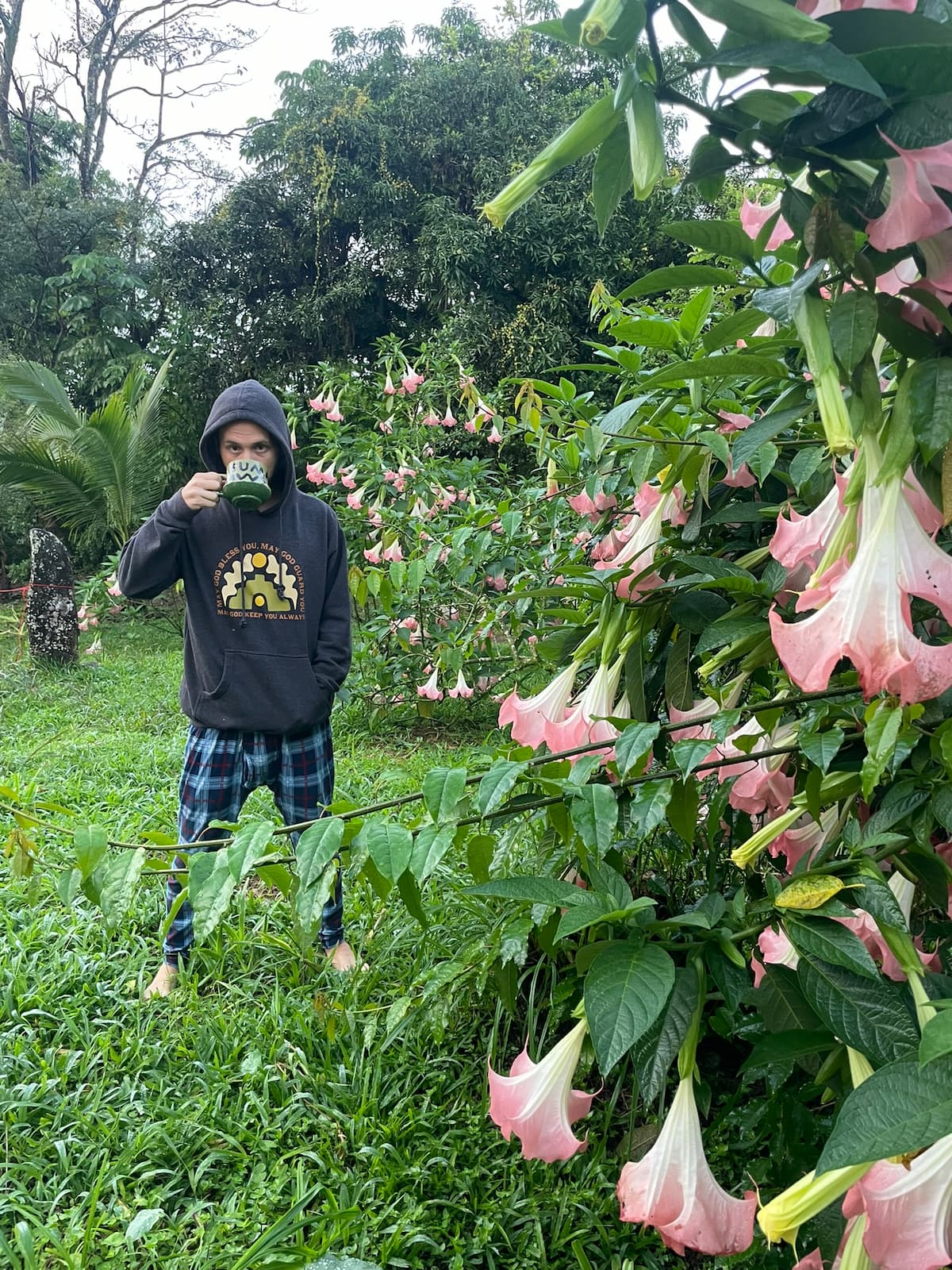
Ok where were we? Ah yes, my wife Yara goes for her walk around now and so I will be with the children when they wake up—cutting fruit for a morning snack and making myself basil tea.
What happens after that depends on the day, but this is my basic morning routine. Every single morning looks exactly like this. This offers a great many advantages, the greatest of which is the possibility of experimentation.
I arrived at the 4am wake up time very gradually and as the result of a study over time to find out exactly how early I can get up without being groggy at all. If I experimented randomly with the wakeup time, without the rest of the routine around it, then this would not be possible. A while back I tried getting up at 3:30am for a few days, but I noticed in my meditations that my mind was too foggy, and the quality of my writing was lesser.
I didn’t always write after meditating either. First it was wake up, meditate, then yoga. However, I noticed that during my yoga practice I was always overflowing with ideas, and so when I tried writing right after meditating I noticed right away this was my most creative time of the day.
Routines for your life
The whole point of reviewing my morning routine was just as an example to help you see the process of finding your own unique version that suits you and your lifestyle. Yours will likely look profoundly different, but finding it will be a very similar process as how I found mine. You begin by studying your life like a scientist, creating ideas and then testing them out.
I chose to start getting up earlier because I have small children who wake up with the sun every morning. If I want some time to myself, my choices are at night when they go to bed, or early in the morning before they wake up. Since my circadian biology and health are paramount to me, I avoid screens before bed so that wasn’t an option.
Look at your main pain points at life and use those to form a routine that may help. Perhaps your mornings are already streamlined, and you actually need a nighttime routine. After all, the quality of your morning is very often determined by the quality of the night before, and therefore the quality of your sleep.
In my house, bedtime is something sacred, ceremonial even. It starts at 5pm, when my wife and I put our phones and screens away until our kids are asleep. This serves a great many purposes, not the least of which is allowing us some time to review the day together and connect as partners. In this way, routines can also help with our relationships, not just optimizing our lives.
This was added to our bedtime routine as a result of wanting more presence and less distractions in the evening. This is the power of routine, it can serve many purposes: guardrails for yourself to protect against unwanted habits, strategies to increase productivity throughout the day, ways to kindle a relationship, or a program for overall health and vitality. Just look through your life, find an area that you want to improve, and establish a routine to get what you want.
Patience is key
An important thing to keep in mind when talking about routines—and being a human in general—is patience. Our civilization is one that has speed at the center of it. When we want something, we want it right now. This works when you’re in the drive through at Burger King, or taking a pharmaceutical pill, but it definitely does not work when building a routine or otherwise trying to make changes to your life. Beyond that, fast usually comes with drawbacks of its own: the fast food burger is filled with poison, and the pharmaceutical pills give the illusion of a cure, just treating the symptoms.
In the natural world—our human reality in terms of our bodies minds and spirits—everything takes time, especially when we are talking about small changes in our daily rhythms. Our existence as humans on this world is a primarily physical reality, and changes in the physical take time to propagate. Sometimes we can get the thing we want fast, but usually it takes time, effort and patience.
Many people will, in a moment of inspiration, build a new life for themselves in their mind. “I’ll get up early, start running, exercising, meditating, eating better,” and so on. Then, when they look in the mirror after 2 days of running and don’t feel any different, or their legs are sore, they give up. Maybe you tried getting up earlier, but felt groggy so you let that go too.
It took me a full month to feel better after I gave up gluten. Until the 4th week, I felt basically no changes at all, until finally my skin rash went away. This is because changes to our lives take time to propagate. It is very likely that you have been living in this way you are currently living for quite some time, so it doesn’t really make sense to expect changes immediately. There is too much momentum.
Routines work because they take work. Running shoes don’t put themselves on, social media apps don’t close themselves, and the only one that can get you out of bed is you. A routine is as close as we could get to a blueprint for a human being.
Your blueprint (or theirs)
What does your blueprint look like right now? It’s there, whether you built it yourself with intention or not. The way I have discussed routines thus far is something very thought out and intentional, but the reality is whether you built your own or not, you are almost certainly living your life through a sequence of routines.
This is a powerful realization, and the sooner you accept it the sooner you open yourself up to true agency in your life. How many times have you been talking to someone, and it feels like you are just talking to a social media feed? You hear someone say something, and you swear you just read that online, or saw it in an ad somewhere.
If you don’t build your own routines, I can promise you there are people that will be happy to build them for you, and they will do it so subtly that you think you built it yourself. Maybe its the perfect milk to your coffee in the morning, or some gadget for your sleep, or perhaps even a green powder you can eat with friends. What they all have in common, is someone stands to profit from you adding something to your routine.
It’s not just about profiting monetarily also. It could just be for the attention, to win you over to their way of doing things for the social clout, or even to just make you more malleable and receptive to outside influence. Routines tie in closely with addiction, and we human beings are absolutely ripe for the picking in this way. We want to be sold something. And how much easier it is to have a bad routine and addictions when you are surrounded by others who do the same. It helps justify your own.
What’s important here is to understand that your current routines, your current blueprint for your life, was not made entirely on your own. It consists, in very large part, of a great many ideas from other people who did not always have your best interests in mind. What’s more, they weren’t yours, they didn’t come from you as a result of a deep study of your life and a comprehensive strategy on how to improve it. More than likely, they were simply picked up along the way, just like a snowball will pick up any stick or dirt or leaf that it should roll over.
It’s time to build your own blueprint, to build your own routines. Take control of your life, and develop your sense of agency. A great way to start is by analyzing your daily rhythms and routines and start to see which ones might be serving you best and which ones aren’t serving you at all. Think through your typical day and where the pain points might be, those areas you tend to struggle with the most. From there, you can strategize and create some new routines that have your own best interests in mind.
And remember, patience is key. You’ve been driving down this road for a long time, so don’t expect to be able to flip a U-turn right away. It takes time for real changes to propagate through our lives and for us to feel the effects within our bodies, minds and spirits.
Thanks for reading.
Many blessings my friends.
Michael